Delivering intelligence at scale.
We’ve reinvented the B2B customer experience to help businesses operate with better speed, scale and service for their customers.
Our AI-powered intelligent digital platform, Xvantage™, turns data into intelligence, giving you the insights you need to grow your business faster.

Why Ingram Micro
You need it? We’ve got it.
That is, everything you need to win at business, from tech to finances to marketing.We treat your business like it’s our own—valuing your people, personalizing your solutions and taking an active role in finding you new opportunities.
How do you reinvent a successful business while it’s still running? Stanford University took a closer look at Ingram Micro’s transformation from IT distributor to platform company. See how the leadership team tackled the challenge of “transforming while performing” and disrupted its own business from within.
Cybersecurity is one of those topics that is constantly evolving and everyone has to be flexible, as the cyber enemies get smarter and more adaptable to the new technologies and security features. Despite the constant need to stay informed and on guard, there are things you can do to adopt healthy habits to keep your customers (and even your own businesses) in a good security position.
1. Adopt AI to help defend, but watch for AI-driven scams.
Artificial intelligence and machine learning have been rooted in cybersecurity for a while now, but GenAI is a force multiplier for cyberenemies to carry out their agenda. They leverage AI to create fake invoices, impersonate a trusted authority or launch sophisticated phishing campaigns—to name a few.
This is an official warning for your customers to be wary of any voice, video or correspondence asking for sensitive data or exhibiting urgent language. Your customers can still use AI-powered email gateways, endpoint detection and cloud security tools to help spot suspicious activity.
2. Train and empower staff.
I’ve said it before and I’ll say it again—the first line of defense will always be the internal team. People are a key part of any good defense, but they can also be the most vulnerable. They make mistakes, fall for scams or simply ignore security best practices. Even the best technical controls can be undermined if users don’t do the basics.
- Conduct recurring security awareness training.
- Teach their employees how to verify links, files and attachments.
- Encourage them to report suspicious behavior.
- Reward them for their efforts when it comes to doing the right thing and making security part of the company culture.
And you can always have your customers send out those practice phishing training emails like we do here at Ingram Micro. They’re very effective in teaching us non-security personnel to be on guard and mindful when opening emails (though it may make folks suspicious of every email, like me…)
3. Plan for compliance and new regulations.
This is a complex topic that will vary depending on the industry/customer and location, so this will be a general explanation.
- Privacy and information laws are constantly evolving. You need a strong understanding of what data your customers store, where it lives and who has access—and they should, too.
- Falling out of compliance can result in legal, reputational and financial consequences. It’s best to ensure that you both document incident response and business continuity plans.
- Make sure your plan with your customers includes proper communication, insurance and legal steps if necessary.
- Organize tabletop exercises with stakeholders to simulate different scenarios.
Think of it like those fire drills we had in grammar school—know the plan, practice the plan and ensure stakeholders on your customers’ teams know what to do should there be a situation.
4. Build a layered approach–also known as “defense-in-depth.”
Attackers will target vendors, third parties and software dependencies as an indirect path to compromise businesses of all sizes. Don’t let your customers put all their eggs in one basket. Here are some quick tips to save you future headaches:
- Actively manage your vendor relationships.
- Adopt a comprehensive, diverse set of protections that aligns to a cybersecurity framework, such as NIST.
- Turn on multi-factor authentication (MFA) everywhere.
- Use least privilege or role-based access controls across systems.
- Run vulnerability scans.
- Back up data and test recovery on a regular basis.
It’s almost like you have to be a doomsday prepper—stocked up and ready to defend cybersecurity posture at any given second. The more palisade defenses you have, the better prepared you are to handle it when the cyber enemies try to show up.
5. Stay informed.
Cybersecurity moves fast, and this list might have changed by the time you finish your morning cup of coffee or tea. Be curious. Subscribe to newsletters. Attend webinars. Keep an eye on the headlines. Incorporate threat intelligence feeds into your day-to-day operations. Be the kind of person who is constantly seeking information on the latest threats, the newest technologies and best practices as we uncover the cyberenemies’ plans.
Of course, you can always call your Ingram Micro representative and we’ll walk you through anything you might need a little extra help with. If there’s a security topic you want to dive deeper into with one of our cybersecurity or AI experts, reach out today.
If your experience with AI so far has been asking ChatGPT to draft an email or summarize a meeting, then you are familiar with the power of generative AI. Generative AI, as experienced using traditional chat-style interfaces, has proven to be an incredibly useful tool. Still, it has a major limitation: it sits there and waits for you to type.
We are now entering the next phase of the technology: Agentic AI, which can seamlessly integrate with your existing systems like CRM, email, and spreadsheets, addressing common technical concerns for small businesses.
For small business owners, this distinction is critical. It's about giving small teams a sense of empowerment and confidence by starting small with pilot projects that let software initiate, decide, and act within clearly defined boundaries. This takes AI from passive observer to active participant. However, it isn't about replacing employees or deploying sci-fi autonomy; it's about augmenting your current workforce.
You can think of it this way:
- Generative AI is a tool, such as a typewriter or a calculator
- Agentic AI is a system, such as a workflow or a delegation
Agentic AI is the difference between software that waits for instructions and software that gets things done.
Agentic AI is your junior assistant
Technically, agentic AI refers to systems that can take a high-level goal, break it down into steps, use tools (like your email, CRM, or spreadsheets), make intermediate decisions, and act repeatedly until the goal is met.
But this sounds abstract. To understand how this fits into your business, don't compare it to software; instead, compare it to a junior operations assistant.
Imagine hiring a bright, junior employee. You wouldn't just say "write this email." Instead, you might say, "Check our inventory every morning. If stock is below 10 units, draft a reorder form, but if it's below 5 units, mark it as urgent and Slack me immediately."
A junior assistant can:
- Check systems - look at inventory
- Follow procedures - compare against the 10-unit rule
- Make decisions - standard reorder vs. urgent escalation
- Escalate - when a situation calls for it, or if unsure of what action to take
Agentic AI does exactly this. It doesn't just talk; it does.
Why this matters specifically for small businesses
Enterprise companies solve problems by throwing headcount at them. Small businesses don't have that luxury, and may face specific constraints:
- The many hats problem: Your best salesperson is also your support lead and occasionally your IT fix-it person
- Trapped knowledge: Critical processes exist only in the owner's head
- Inconsistent execution: You know what to do, but because you are busy, it doesn't always get done
The value proposition here is non-technical. Agentic AI isn't about making your business "smarter" in a creative sense; it makes your business more consistent.
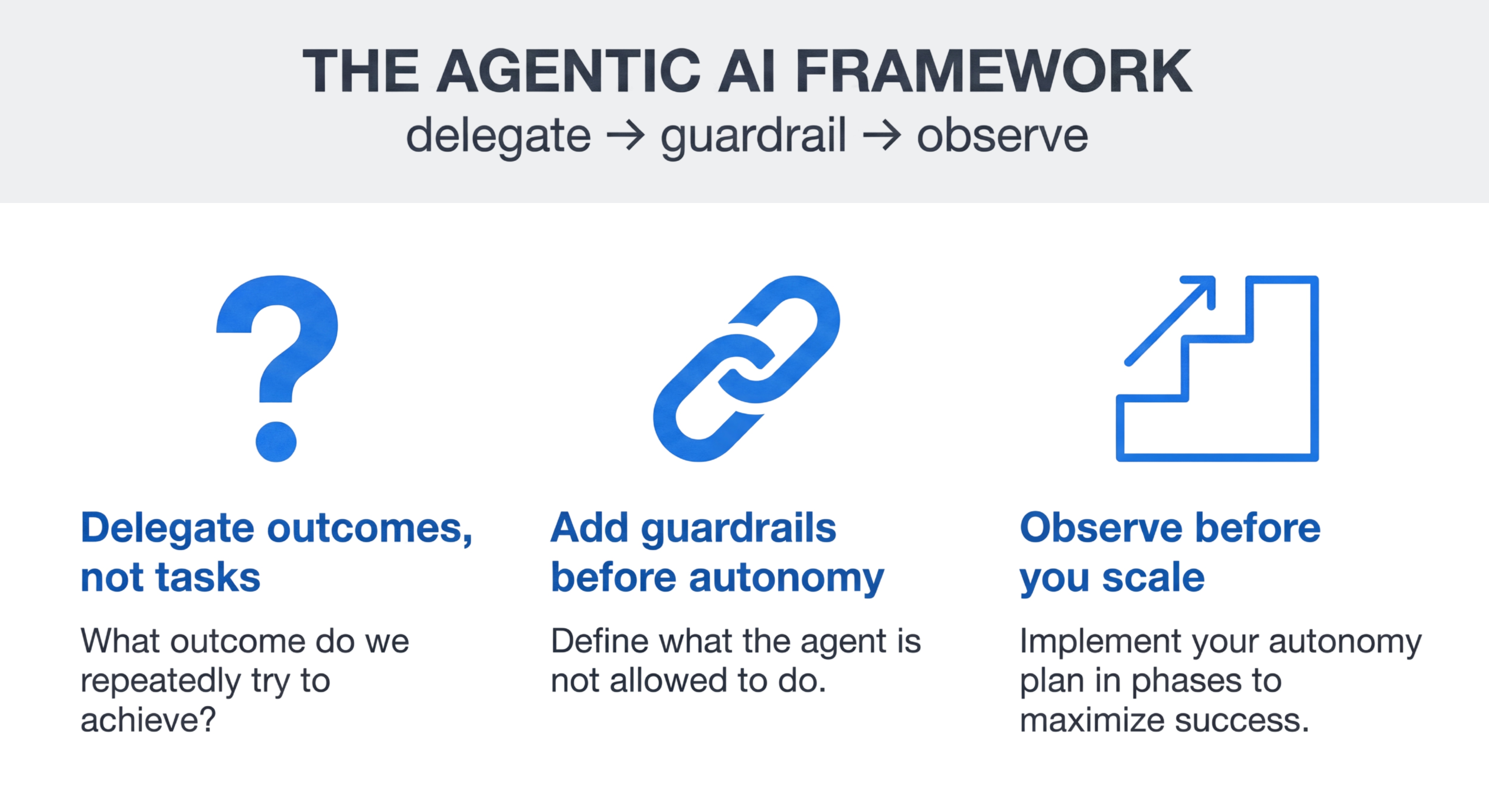
The agentic AI framework: Delegate → guardrail → observe
Let’s see how a framework can help with implementation. The delegate, guardrail, observe paradigm is both lean and sufficient to get the job done without massive disruption to your business.
1. Delegate outcomes, not tasks
Don't ask "What can this AI tool do?" Ask "What outcome do we repeatedly want to achieve?"
- Bad delegation: "Write a sales email."
- Good delegation: "Manage the follow-up process for all leads who haven't replied in 48 hours."
2. Add guardrails before autonomy
Agentic AI works best when it is constrained, not free roaming. You must define what the agent is not allowed to do.
- Permissions: Can it draft the email, or send it?
- Budget: Can it spend up to $50, or $0?
- Escalation: "If the customer uses the word 'angry' or 'refund', stop and alert a human."
3. Observe before you scale
To eliminate faulty autonomous actions and tweak your agentic workflow early, start in "recommendation mode." Phase in your autonomy plan to avoid being surprised by outcomes.
- Phase 1: The agent suggests an action ("I recommend sending this email"). You approve it.
- Phase 2: You review the agent's logs weekly.
- Phase 3: Once the agent is 99% accurate, you allow it to act autonomously.

Practical use cases: Focus on leverage, not magic
When implementing agents, we stop thinking about prompts (single interactions with AI) and start thinking about loops. We want to think in, and build, a cycle of goal → decision → action.
Here are some examples of what this looks like in the real world.
1. Operations: The "inventory watchdog"
The agentic loop for our inventory watchdog would be rooted in monitoring your inventory database 24/7. The goal could be something like "prevent stockouts without manually checking spreadsheets daily." Then comes the decision: Is stock item A < threshold B? If yes, is the preferred vendor available? Finally comes the action: The agent drafts a purchase order and places it in your "to approve" folder. It creates the leverage; you provide the final sign-off.
2. Sales and CRM: The "lead nurturer"
The lead nurturer has an agentic loop of watching incoming leads and CRM activity. Its goal? To ensure no lead goes cold. The decision could be a simple set of rules such as: Has this lead responded in 3 days? If no, send follow-up #1. If yes, analyze the sentiment. Is it positive or negative? If positive, the action could be to schedule a meeting on your calendar. If negative, tag as "not interested" in the CRM to keep your data clean.
3. Finance: The "invoice chaser"
The agent's loop. Scan unpaid invoices. The goal would be to reduce the number of days sales outstanding (DSO). The decision: Is the invoice 5 days overdue? Send a polite reminder. Is it 30 days overdue? Draft a sterner email and flag it for the CFO. And finally, the action would be for the agent to automatically manage the follow-up cadence, ensuring cash flow isn't disrupted by human forgetfulness.
Reality check: What agentic AI is not
To prevent disappointment, limitations should be clearly outlined. Despite its robust capabilities, agentic AI is not a silver bullet. It won’t fix broken processes. If your current invoicing process is a mess that no one understands, an AI agent will automate the mess. Agentic AI also requires ownership. As the process manager, you are responsible when the agent makes a mistake. Remember this agentic golden rule: If a process is unclear to a human, it will be unclear to an AI agent.
Getting started: A sensible entry path
Don't overhaul your entire company overnight. You should treat your experimentation with agentic AI as a pilot program. First, identify one boring workflow. Pick something rules-based, repetitive, and low-risk, such as categorizing support tickets or checking for missing receipts. Then, document the decision points in the workflow by writing down exactly how you make the relevant decisions (e.g., "If X then Y"). Make sure you define evaluation metrics as well to assess outcomes.
Time to implement. Start with limited autonomy: allow the agent to draft the work, but require human approval before completing the action, such as "send" or "finalize." Once this is done, you measure outcomes. Was there a measurable positive impact on your business results? Did you save time? Did consistency improve? Did you increase revenue? Success begets success. Once you see the possibilities of agentic AI in your own business, practical success can follow by repeating this incremental approach.
The strategic takeaway
Over the coming few years, the competitive gap between small businesses won't be about who uses AI; it will be about who delegates effectively to it. Agentic AI allows you to scale your execution, not just your ideas. It is the force multiplier that allows a team of five to operate with the consistency and capacity of a team of twenty.
If you've been hearing about "the cloud" for years but still aren't sure what it means for your business, we get it. Let's cut through the noise.
Put simply, cloud computing (aka “the cloud”) is renting computing power instead of buying it. Rather than purchasing servers, software licenses, and IT gear that sits in your office, you access these resources over the internet on a pay-as-you-go basis.
It’s like switching from owning a car to using rideshare. You still get where you need to go, but someone else handles maintenance and repairs while you focus on running your business.
What cloud computing IS
Cloud computing delivers servers, storage, databases, and software over the internet on-demand. Instead of investing in expensive hardware that becomes outdated, you access resources as needed from cloud providers. The three main types are Infrastructure as a Service (IaaS), Platform as a Service (PaaS), and Software as a Service (SaaS).
For most businesses, SaaS applications like email, accounting software, or CRM tools are your first cloud experience. These web-based apps eliminate software installations and provide automatic updates. All you need to do is select the provider that fits your needs, and their software is available for your business to use nearly instantaneously.
What cloud computing ISN'T
Cloud computing isn't just storing files online, though that's often where you start. It's also not a magic solution that automatically fixes all IT problems. Many business owners worry about security, but reputable cloud providers often offer better security than most small businesses can implement on their own.
Cloud computing also isn't necessarily more expensive. While costs vary based on services, resources, and usage, many businesses find significant savings by eliminating hardware purchases, maintenance contracts, and extensive IT staff needs.
Why the cloud actually makes sense for your business
Immediate cost relief: You can achieve over 35% in annual operating cost savings by deploying cloud services. This is accomplished by eliminating large upfront expenses for hardware and software, reducing IT maintenance costs, and only paying for what you actually use.
Business agility that works: The cloud lets you scale resources up or down based on actual demand rather than planning for peak capacity year-round. Busy season? Increase computing power instantly. Slower periods? Scale back and reduce costs. This flexibility is gold for growing businesses that can't predict future IT needs.
Real disaster recovery: Cloud providers store your data in multiple locations, offering better disaster recovery than most businesses achieve independently. Power outage, flood, or other disruption? Your data and applications remain accessible from any internet connection. Many cloud services provide 99.9% or better uptime guarantees.
The hard truth about getting started
Before moving to the cloud, it’s imperative that you assess your current IT costs including hardware, software licenses, maintenance, and staff time. Consider your growth projections and whether your current systems can scale appropriately.
Start small with one or two applications rather than attempting a complete migration immediately. Many businesses begin with email or file storage services before moving critical applications to the cloud. This gradual approach builds confidence while minimizing risk.
Work with experienced partners who can guide you through the decision-making process. Look for providers who offer comprehensive support, transparent pricing, and proven expertise across multiple cloud platforms. The right partner helps you understand not just what's possible, but what makes sense for your specific situation.
Cloud computing isn't about following technology trends. It's about positioning your business for sustainable growth while reducing operational complexity. When implemented thoughtfully, cloud services provide the foundation for innovation, efficiency, and competitive advantage.
Discover Ingram Micro Xvantage
A single destination for growth
Ingram Micro is forging new paths, transforming legacy B2B processes through a single destination B2C digital experience. Our digital distribution experience platform, Ingram Micro Xvantage, is the next-level way for technology providers to transform business potential, discover new opportunities and reshape customer perception.
Partner with us
Be part of the bigger picture
Partner with Ingram Micro to learn how you can create a better experience for your customers.
Ingram Micro Sustainable Impact
Measuring what matters
Ingram Micro helps businesses run better, grow faster and achieve their sustainability goals. We’re also equally as disciplined when it comes to measuring our own material impacts on people and the planet.
Xvantage is saving us time and helping us streamline the way we do our work.
— Anna Wesley International Partner Alliance Manager, Distribution at SHI
How far can you grow?
Join more than 165K customers and 1,500+ vendors already growing.